


|
Quantity
|
Cost
|
||
|
|
|||
Lighting Sensors: How to Choose One for LED Lighting
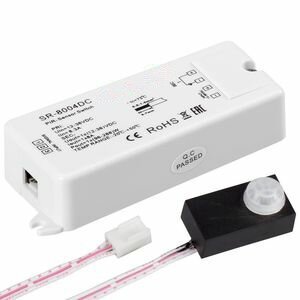
Lighting sensors automatically switch or regulate LED lighting based on motion, human presence or ambient light level. They improve convenience and help reduce energy use. Choose a sensor by its operating principle, mounting location, voltage and controller compatibility.
Short answer: use a compact infrared sensor for furniture, a PIR motion sensor for corridors and stairs, and a presence sensor with light-level control for offices.
Which sensor to choose for each task
| Sensor type | How it works | Where to use it |
|---|---|---|
| PIR motion sensor | Detects changes in infrared radiation | Corridors, stairs, storage rooms |
| Presence sensor | Detects a person even with small movements | Offices, washrooms, work areas |
| Light sensor | Measures daylight or artificial light | Automatic switching and brightness control |
| Microwave sensor | Detects motion from reflected radio waves | Large rooms, partitions, technical areas |
Important: if the sensor output is not rated for the strip current, connect it through a dimmer, relay or controller.
PIR or microwave sensor
A PIR sensor reacts to thermal movement and suits ordinary rooms. A microwave sensor can detect movement through thin partitions and respond to small movements, but it requires more precise adjustment.
How to connect a sensor
Check the voltage, output type and rated load. For low-voltage strip, use the sensor with a controller or dimmer. Set the off-delay, sensitivity and light threshold.
Frequently asked question
Can a sensor be connected directly to an LED strip?
Only when its output is rated for the strip voltage and current. Otherwise, use a controller, dimmer or relay.
Conclusion
Choose a sensor by detection zone, output type, voltage and load. PIR suits passageways, a presence sensor suits rooms where people stay for longer, and a light sensor provides automatic brightness control. Check compatibility with the LED system before connecting it.
ARTLED can help you choose a sensor, controller, dimmer or relay for automatic LED system control.