Flexible Neon: What It Is and How to Choose LED Neon for Home and Business
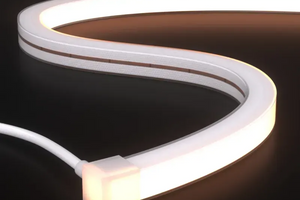
Flexible neon (LED neon flex) is an LED strip embedded in a solid silicone or PVC jacket with a diffuser, producing an even, continuous glow with no visible diode dots, mimicking classic glass neon. Unlike a regular LED strip, flexible neon is sealed, moisture-resistant (IP65–IP68), bends in one plane or in multiple planes (3D neon), and doesn't need an aluminum profile for even light output. Choose it based on voltage (12V/24V/220V), type (2D or 3D), color (single-color, RGB, RGBW), and IP rating — depending on whether it's installed indoors or outdoors.
What flexible LED neon is and how it differs from LED strip
Flexible neon uses the same components as a regular LED strip: a flexible PCB with SMD LEDs, copper contact traces, and sometimes resistors. The key difference is that the strip is sealed inside a solid silicone tube (less often PVC) with a frosted or clear diffuser. This jacket serves three purposes: it diffuses the LED light into an even line, protects the board from moisture and mechanical damage, and gives the product the flexibility and aesthetic of classic glass neon.
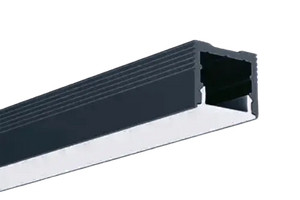
Unlike an LED strip in an aluminum profile, neon doesn't need a profile for even light output — the diffuser is built directly into the jacket. This simplifies installation on curved surfaces, signage, and three-dimensional structures.
Main types of flexible neon
✓ 2D neon (side-glow / top-glow) — the PCB sits in a single plane and bends only horizontally, like a regular strip. The most common and affordable type
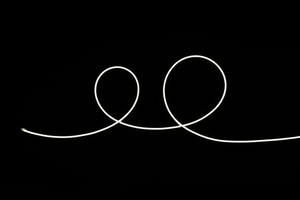
✓ 3D neon (flex neon) — a jacket with slits or a special structure lets you bend the neon in any plane, including forming letters and three-dimensional shapes
✓ One-sided neon — emits light in one direction, suitable for contour lighting, ceiling perimeters, furniture
✓ 360° (round) neon — glows around the entire cross-section, used for hanging and decorative structures not mounted flush against a surface
✓ Addressable neon (WS2812B/SK6812 in a neon jacket) — each pixel is controlled individually, enabling animations and color gradients
Technical parameters: cross-section, voltage, IP rating
Cross-section (jacket size): the most common formats are 6×12 mm, 8×16 mm, 10×20 mm, 12×24 mm. A larger cross-section means higher power and brightness, but a larger minimum bend radius.
Supply voltage:
✓ 12V/24V DC — for runs up to 10–15 m, requires a power supply, safe extra-low voltage (SELV)
✓ 220V AC — has a built-in rectifier in every segment, allowing runs of 25–100 m without a separate power supply, the standard for signage and facades
IP rating: most neon already has IP65 by default thanks to its sealed jacket. For direct water contact (pools, fountains, underground installation), choose IP67 or IP68 with sealed end caps.
Bend radius: for 2D neon with an 8×16 mm cross-section, the typical minimum bend radius is 40–50 mm in the horizontal plane. 3D neon allows a 25–30 mm radius in any plane thanks to its slitted internal structure.
Cutting interval: cut marks are placed every 2.5–10 cm depending on the model — the exact interval is always specified on the jacket itself or in the datasheet. Cut only at the marked points.
Comparison table: LED neon vs LED strip vs glass neon
| Parameter | LED neon | LED strip in profile | Glass neon |
|---|---|---|---|
| Light uniformity | High, no dots | Depends on profile | High |
| Flexibility / letter shaping | Yes (3D version) | Limited by profile | Yes, but fragile |
| Impact resistance | High (silicone) | Medium (profile + diffuser) | Low, glass breaks |
| Power consumption | 7–14 W/m | 4.8–19.2 W/m | Significantly higher (needs a high-voltage transformer) |
| Default IP rating | IP65 and above | IP20 (needs an IP-rated profile) | Requires sealing |
| Lifespan | 30,000–50,000 h | 30,000–50,000 h | 8,000–15,000 h |
| Typical use | Signage, contours, decor | Functional lighting | Retro signs, art installations |
Where to use flexible neon at home
✓ Floating-ceiling contour lighting — 8×16 mm 2D neon, single-color or RGB
✓ Bed headboard, mirror, and shelf lighting shaped into custom lines
✓ Decorative signs and logos for a home bar, office, or kids' room — 3D neon
✓ Stair and baseboard lighting with an even, dot-free line effect
✓ Accent lighting for terraces, balconies, or pools — IP67/IP68 neon
Where to use flexible neon in business
✓ Signs and light boxes — 220V neon, long runs without separate power supplies every few meters
✓ Contour lighting for storefronts and shop windows — IP65–IP67
✓ Neon signs for cafes, bars, and restaurants — 3D neon, custom letter shapes
✓ Ceiling and reception area lighting in offices and hotels
✓ Dynamic addressable lighting for stages, displays, and exhibition stands — addressable neon with DMX/SPI control
How to choose flexible neon: a step-by-step guide
✓ 1. Determine the installation location — indoors (IP65 is enough) or outdoors/wet areas (IP67–IP68)
✓ 2. Assess the shape of the run — straight sections and gentle curves suit 2D neon; complex signs and three-dimensional shapes need 3D neon
✓ 3. Calculate the run length — up to 15 m, choose 12V/24V; longer, choose 220V
✓ 4. Choose the color and color temperature — single-color (2700–6500K) for functional lighting, RGB/RGBW/addressable neon for decor and accents
✓ 5. Match the cross-section to the brightness needed — 6×12 mm for subtle accents, 10×20 mm and up for bright signage
✓ 6. Check the kit contents — mounting clips, end caps, and silicone sealant for joints should be included or purchased separately
Common mistakes when choosing and installing LED neon
✓ Cutting neon outside the marked points — damages the board and disables the segment
✓ Not sealing the ends after cutting — moisture gets inside the jacket and the diodes corrode
✓ Choosing IP65 for underground or pool installation — at least IP68 with sealed end caps is required
✓ Bending 2D neon in the vertical plane — the board breaks; three-dimensional shapes require 3D neon specifically
✓ Ignoring the manufacturer's bend radius — too sharp a bend damages the internal board even in the 3D version
✓ Spacing mounting clips wider than the manufacturer's recommendation — the neon sags and the line looks uneven
Frequently Asked Questions (FAQ)
How does flexible neon differ from a regular LED strip?
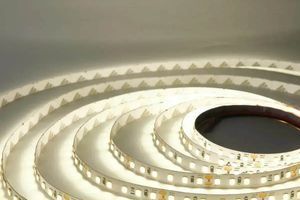
Neon is sealed inside a solid silicone jacket with a diffuser, so it glows as an even line with no visible diode dots and has built-in moisture protection (IP65 and above). A regular strip needs an aluminum profile to achieve a similar effect.
Can LED neon be cut, and where exactly?
Yes, but only at the marked cutting points, placed on the jacket every 2.5–10 cm depending on the model. After cutting, the end must always be sealed with silicone or a dedicated end cap.
What's the difference between 2D and 3D neon?
2D neon bends only in one plane, like a regular strip. 3D neon, thanks to its special jacket structure, bends in any direction, allowing letters, logos, and three-dimensional shapes to be formed.
Which neon should I choose for outdoor use?
At least IP65 for locations shielded from direct rain; IP67–IP68 for direct water contact, underground installation, or pools. Also check that the end caps are properly sealed.
Does 220V neon need a power supply?
No, a separate low-voltage power supply isn't needed — the rectifier is built into the neon cable itself, allowing runs of 25–100 m to be connected directly to the 220V mains.
How long does flexible LED neon last?
With quality components and proper operating conditions, flexible LED neon lasts 30,000–50,000 hours — substantially longer than traditional glass neon (8,000–15,000 hours).
Conclusion: making the right choice
For home decor projects and short runs up to 15 m, choose a 12V or 24V 2D neon with IP65 — that's enough for contour lighting on ceilings, furniture, or mirrors. For signage, facades, and complex signs, consider 220V or 3D neon with a higher IP rating. The key is to pin down the installation location, run length, and shape first, then match the remaining parameters (cross-section, color, IP rating) to those conditions.