The claimed 30,000–50,000 hours of LED strip lifespan isn't the moment the diodes burn out — it's the L70 point: the runtime after which brightness drops to 70% of its initial value. LEDs don't "burn out" suddenly like incandescent bulbs — they gradually dim as the phosphor layer and semiconductor die degrade. The real speed of that degradation depends not on the number printed on the box, but on operating temperature, current, chip and PCB quality, and installation conditions. In this guide, the ARTLED team explains what "lifespan" actually means, which factors can cut a strip's real-world life several times over, and how to avoid that.
What "30,000 hours" actually means: the L70 and LM-80 standard
LED chip manufacturers (Samsung, Epistar, Osram, and others) test batches of dies under the LM-80 standard — measuring brightness decay across dozens of samples over 6,000–10,000 hours of continuous operation under controlled conditions. That data is then extrapolated using the TM-21 methodology to project when brightness will reach L70 (70% of initial output) — and that projected number is what gets printed on the box as "lifespan."
Main factors that accelerate brightness degradation
✓ Junction temperature. The single biggest factor. By the Arrhenius rule, every +10°C added to the p-n junction's operating temperature roughly halves the time to reach L70 — a strip officially rated for 50,000 hours at 25°C can drop to 70% brightness in as little as 15,000–20,000 hours if it runs continuously at 55–60°C.
✓ Operating current and overdrive. Powering a strip above its rated wattage (e.g. an oversized PSU voltage or undersized trace resistance) increases the current through every diode — brightness rises short-term, but phosphor degradation speeds up non-linearly.
✓ Chip quality. Branded dies (Samsung, Epistar) have a more consistent phosphor mix and tighter silicon-substrate quality control than unbranded chips with minimal testing — the real-world time to L70 can differ by 2–3x under identical conditions.
✓ PCB heat dissipation. Copper trace thickness (1oz vs 2oz) and the flexible substrate material determine how fast heat spreads away from each chip — a strip mounted bare on wood or drywall runs hotter than the same strip seated in an aluminum profile.
✓ Power supply quality. Voltage ripple, inrush spikes, and lack of regulation load the chips unevenly — cheap PSUs without a proper output filter accelerate degradation even at a nominally correct rated voltage.
✓ Humidity and chemical exposure. Without adequate IP protection, moisture gradually oxidizes contact pads and copper traces, raising local resistance and heat right at the oxidized spots — this drives localized, not uniform, degradation.
✓ UV exposure. Direct sunlight breaks down the silicone potting on addressable and IP-rated strips and yellows the clear phosphor-layer silicone — relevant for outdoor installs without additional shading.
Estimated real-world lifespan by installation conditions
| Installation conditions | Real-world life to L70 |
|---|---|
| Quality chips, aluminum profile, rated power, quality PSU | 40,000–50,000 h (rated lifespan achieved) |
| Quality chips, no profile, rated power | 25,000–35,000 h |
| Unbranded chips, no profile, current overdrive | 10,000–15,000 h |
| Outdoor install, unshaded from direct sun, insufficient IP rating | 8,000–15,000 h (oxidation accelerates failure) |
How to extend an LED strip's lifespan
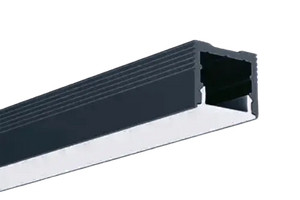
✓ Mount it in an aluminum profile. A profile dissipates heat from the PCB 3–5 times more effectively than mounting directly on any surface — the single cheapest way to lower junction temperature.
✓ Don't exceed the rated wattage. Confirm the PSU voltage matches the strip's rating (12V/24V/48V) rather than running it "with headroom" — a stable rated voltage matters more than peak brightness.
✓ Choose a quality regulated power supply. A PSU with low ripple and overvoltage protection reduces thermal stress on every individual diode.
✓ Match the IP rating to the install location. For bathrooms, kitchen sink areas, or outdoors — use a strip with proper silicone protection (IP65/IP67/IP68), not an open IP20 version.
✓ Avoid running at 100% brightness constantly. Dimming to 70–80% meaningfully cuts diode current and temperature while barely affecting perceived brightness.
✓ Shield outdoor strips from direct UV. Mounting in shaded recesses or under an overhang extends the silicone potting's life and prevents yellowing.
Signs of degradation: how to recognize it
Natural degradation shows up as a uniform, gradual brightness drop across the entire strip over months or years — unlike a sudden dimming of one section (a sign of a local contact issue or overheating) or a gradient from one end to the other (that's voltage drop, not chip degradation). Other signs to watch for: a gradual color-temperature shift toward yellow as the phosphor ages, a barely perceptible flicker at maximum brightness, and uneven "dim patches" at spots with worse heat dissipation.
Common mistakes
The most common mistake is choosing a strip on price alone, ignoring chip brand and copper trace thickness — both of which directly affect real-world lifespan. Other frequent missteps: mounting a high-power strip (14.4 W/m and up) without an aluminum profile "to save money," using an unregulated PSU with less than 20% power headroom, installing an IP20 strip in a wet zone "because it still works," running constantly at 100% brightness instead of a light dim, and skipping shading for outdoor installs under direct sun.
Frequently asked questions
Can a degraded LED strip's brightness be restored?
No — phosphor and chip degradation is an irreversible physical process. The only fix for noticeable dimming is replacing the strip.
How many years will an LED strip last under normal household use?
At 8 hours of use per day, the claimed 50,000 hours works out to over 17 years to reach L70. A quality strip mounted in a profile typically outlasts the point at which owners replace their lighting for a redesign anyway.
Does dimming affect lifespan?
Yes, positively — running at reduced brightness means lower current through the diodes, lower junction temperature, and therefore slower phosphor degradation.
How does the warranty differ from the lifespan rating?
The warranty (typically 1–3 years) is the manufacturer's commitment against factory defects. The L70 lifespan (30,000–50,000 hours) is a calculated brightness-degradation figure under normal conditions, which usually far exceeds the warranty period.
Conclusion
An LED strip's stated lifespan is an LM-80/TM-21 calculation to the L70 point, not a guarantee it will perform "like new" for that entire span. The real-world lifespan depends above all on junction temperature: a quality aluminum profile, the correct rated voltage, and a stable power supply can extend practical service life 2–3x compared to a strip mounted without heat dissipation and run overdriven.