LED Profile for LED Strip Lights: Types, Sizes, and How to Choose — Full ARTLED Guide
An LED profile is an aluminum or silicone channel that an LED strip is glued into. It performs three functions at once: it draws heat away from the diodes (extending their lifespan 2–3 times), it diffuses point-source light into a smooth line, and it protects the strip from dust, moisture, and mechanical damage. The ARTLED catalog offers more than a dozen profile types — from simple surface-mounted ones to fully recessed "plaster-in" designs — and in this article we'll break down how they differ and which one fits your project.
Why You Need an LED Profile for an LED Strip
You can glue a strip directly to a surface without a profile, but in practice this quickly leads to overheating and diode degradation. A profile solves several problems at once:
✓ Heat dissipation. The aluminum body acts as a heat sink and draws heat away from the strip's PCB — without it, diodes degrade faster and brightness drops within 1–2 years.
✓ Even light without visible "dots". The diffuser hides individual diodes, turning them into a continuous line of light.
✓ Strip protection. The profile covers the contacts and PCB from dust, moisture, and accidental impact.
✓ Clean, finished look. Instead of a "bare" strip on the surface, you get a neat line of light recessed into furniture, a ceiling, or a wall.
✓ Easy maintenance. A strip inside a profile with a diffuser can be replaced easily without redoing the whole installation.
Main Types of ARTLED LED Profiles and Where to Use Them
In the ARTLED catalog, profiles are grouped by mounting method. Here are the main categories with examples of specific models:
✓ Surface-mounted profile — attaches on top of a wall, ceiling, or furniture front. The simplest option to install. Example: LP12eCh — a deep U-shaped anodized profile, a full analog of the original LP12, works as a heat sink, and comes with the milky-opal LRMe diffuser. The rectangular COLORS LS1613 profile also belongs to this category.
✓ Recessed (flush-mount) profile — installed into a pre-cut groove (in a furniture panel or drywall) so its top edge sits flush with the surface. Example: LPV12.
✓ Plaster-in profile — fully hidden inside a wall or ceiling: mounted into a groove with adhesive, with the profile's "wings" embedded under a layer of plaster. After finishing, only a thin line of light is visible — the profile itself disappears. Example: LPSh20 (3 m).
✓ Corner profile — mounted at a 30° or 60° angle to the surface, most often used in furniture, display cases, and retail fixtures. Examples: LSU and LPU17e (17×17 mm cross-section).
✓ Stair-nosing profile — an anodized aluminum edge cap with a groove for the strip, which both illuminates and protects the edge of a stair tread. Example: LPUU.
✓ Suspended (pendant) profile — hung on cables or suspension mounts below the ceiling, used for linear luminaires. Example: ALUMLED LP30301F with a diffuser.
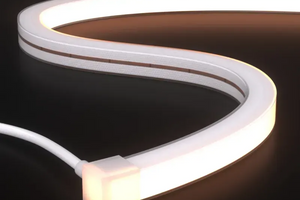
✓ Flexible silicone profile — used wherever the profile needs to follow a curve (arches, round ceilings, complex-shaped furniture). Example: PROLUM D34 SERIES "PRO", round cross-section.
| Profile Type | Mounting | Where to Use | ARTLED Model Example |
|---|---|---|---|
| Surface-mounted | On top of wall/furniture | Shelves, kitchen fronts, decor | LP12eCh, LS1613 |
| Recessed | Flush in a groove | Furniture, drywall structures | LPV12 |
| Plaster-in | In groove, embedded in plaster | Hidden light lines in wall/ceiling | LPSh20 |
| Corner | At 30°/60° angle | Furniture, display cases, retail fixtures | LSU, LPU17e |
| Stair-nosing | On the stair edge | Stair lighting and edge protection | LPUU |
| Suspended | On cables below ceiling | Offices, linear luminaires | ALUMLED LP30301F |
| Flexible silicone | Adhesive/clips, bends | Arches, curved surfaces | PROLUM D34 |
LED Profile Diffusers: Which One to Choose
The diffuser determines how even the light looks and whether individual diodes are visible. ARTLED offers three main options:
✓ Frosted (opal, milky white) — for example, the LRMe diffuser. Hides individual diodes almost completely and produces soft, even light. The optimal choice for strips with a density of up to 120 diodes/m.
✓ Clear — provides maximum brightness, but individual diodes may be visible. Best for high-density strips (120 diodes/m and above) or COB LED strips, where the light is already even.
✓ Black/smoked prismatic — for example, CV-LR1613FP2500-B for the LS1613 profile. Light transmission is about 85%; the profile itself is nearly invisible in daylight, while the lit strip creates a decorative effect.
How to Choose an LED Profile for Your Project: 5 Criteria
✓ Strip width. The profile's internal width must be at least as wide as the strip — 8–10 mm is standard, while COB strips are often wider.
✓ Strip power. The higher the power (W/m), the more substantial a profile you need — thin aluminum simply can't dissipate all the heat.
✓ Operating conditions. Wet areas (bathrooms, kitchens, facades) need a closed profile paired with an IP65/IP67 moisture-resistant strip; dry rooms work fine with an open profile.
✓ Mounting method. Surface-mounted is the simplest solution requiring no surface prep; recessed and plaster-in profiles give the cleanest result but need to be planned during renovation.
✓ Length. Profiles are sold in 2, 2.5, or 3-meter lengths. For longer runs, profiles are butted end to end or joined with connectors — the seam is barely noticeable.
Mounting an LED Profile to Different Surfaces
The mounting method depends on the base material:
✓ Drywall. Butterfly anchors, mounting clips, or double-sided tape for lightweight profiles. Don't overtighten screws — drywall can crack.
✓ Wood. Simply wipe the surface with a damp cloth and let it dry. Then use wood screws, clips, or adhesive, leaving a small gap for heat dissipation.
✓ Concrete. The most demanding surface: it's sanded, holes are pre-drilled, and the profile is secured with screw anchors, expansion anchors, or construction adhesive.
✓ Metal. The surface must be degreased first, then mounted with silicone adhesive sealant or acrylic mounting tape; for extra strength, add metal screws or rivets.
Common Mistakes When Choosing and Installing LED Profiles
✓ Profile narrower than the strip. The strip doesn't fit into the groove, and the diffuser doesn't close properly.
✓ Clear diffuser on a low-density strip. With a 60 diodes/m strip, a clear diffuser will show individual bright points instead of a smooth line.
✓ Cutting corners on the profile for a high-power strip. A thin profile can't dissipate enough heat — diodes overheat and degrade faster.
✓ Mounting on metal without degreasing. Adhesive or tape will only hold for a few months before peeling off.
✓ Missing end caps. Without them, dust and moisture get into the profile and the strip's contacts remain exposed.
✓ Ignoring thermal expansion. On long runs, a profile installed without an expansion gap can warp with temperature swings (for example, the LS1613 profile expands by about 0.8 mm per 10°C change).
Frequently Asked Questions About LED Profiles
What's the difference between a surface-mounted and a recessed profile?
A surface-mounted profile attaches on top of a wall or furniture and needs no surface prep. A recessed profile is installed into a pre-cut groove so its top edge is flush with the surface — giving a cleaner, "built-in" look.
Which profile should I choose for a 120-diodes-per-meter strip?
Almost any surface-mounted or recessed ARTLED profile with a frosted diffuser works well — a density of 120 diodes/m already produces even light even without heavy diffusion, so a clear diffuser can also be used.
What is a plaster-in profile and why would I need one?
It's a profile (such as the LPSh20) installed into a groove in a wall or ceiling and partially embedded under a layer of plaster. The result is that after finishing, only a thin line of light is visible — the profile body itself disappears.
Can an aluminum LED profile be bent?
No, anodized aluminum profiles are rigid and cannot be bent. For curved surfaces (arches, round ceilings), flexible silicone profiles such as the PROLUM D34 are used instead.
Do I need extra accessories for the profile?
Yes — end caps and mounting clips are usually sold separately from the profile and diffuser. It's best to order them together so the profile is fully sealed against dust and moisture.
What warranty do ARTLED LED profiles come with?
For example, the LS1613 profile kit carries a 5-year manufacturer warranty — a good benchmark for most premium-grade aluminum profiles.
Conclusion
An LED profile isn't just a cosmetic accessory — it's an essential part of any quality LED lighting installation: it dissipates heat, protects the strip, and evens out the light. The ARTLED catalog covers every major profile type — surface-mounted, recessed, corner, plaster-in, stair-nosing, and flexible silicone — along with matching diffusers and accessories for each project type. If you're unsure which profile fits your strip and space, the ARTLED team at artled.com.ua can help you put together the right kit.