Outdoor LED Lighting: Which Strips Withstand Frost, Rain and Sun
Illuminating a facade, pergola, garden path or fence — LED strips have become a popular solution for outdoor lighting. But not every strip will survive temperature swings, heavy rain and direct sunlight. If you take a standard indoor model and hang it outside, it will fade, flicker or fail completely within a single season. In this article we break down what to look for when choosing an LED strip for outdoor use and how to avoid wasting your money.
IP Rating: The Key Parameter for Outdoor Use
The first thing to check is the IP (Ingress Protection) marking. This is the international standard that describes the level of protection against solid particles and moisture. It consists of two digits: the first indicates dust protection (0 to 6), the second indicates water protection (0 to 9).
For outdoor use, the following protection classes are relevant:
- IP65 — protection against dust and pressurised water jets. Suitable for installation under canopies, on building walls and under roof overhangs.
- IP67 — withstands brief submersion in water up to 1 metre deep. Well suited for paths, kerbs and areas where water accumulates.
- IP68 — full submersion for extended periods. Used in fountains, pools and underwater decorative installations.
Strips rated IP44 or IP54 are designed for damp indoor spaces such as bathrooms and kitchens. Taking them outside is not advisable: after the first serious downpour the contacts will begin to oxidise and the potting compound will degrade.
Temperature Range: Who Will Survive the Winter
Most quality outdoor LED strips are rated for an operating range of -40°C to +60°C. This covers conditions across the vast majority of regions — from cold winters to hot summer days in warmer areas.
What to pay attention to:
- Type of potting compound. Strips are coated with silicone or polyurethane to protect against moisture and dust. Silicone handles frost better, stays flexible at low temperatures and does not crack. Polyurethane is cheaper but can stiffen and crack when bent in the cold.
- PCB quality. Budget strips may flicker or have sections go dark in extreme heat or cold — a sign of low-grade board material and poor soldering.
- Power supply. Even if the strip itself can handle frost, a standard indoor power supply may fail at sub-zero temperatures. For outdoor use, choose a driver rated IP65 or IP67 with a temperature range down to -30°C or lower.
UV Resistance
Direct sunlight is a serious threat to ordinary LED strips. Ultraviolet radiation breaks down unprotected plastic and potting compound: within one to two years the strip yellows, becomes brittle, the protective layer cracks and moisture gets inside.
To avoid this, look for:
- The marking UV-resistant or UV-stable in the product specifications. This means the potting compound or casing is made from materials containing UV stabilisers.
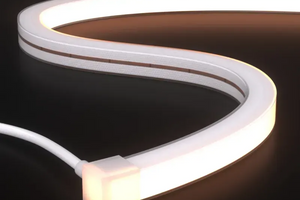
- Silicone tube or profile housing. Strips enclosed in a silicone tube (commonly called neon flex or round flex) handle sun exposure well — quality silicone does not yellow or crack for years.
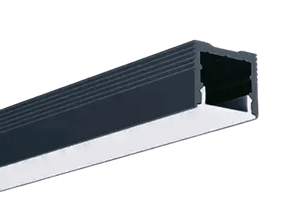
- Aluminium profile with frosted diffuser. Mounting a strip inside an aluminium profile gives protection from mechanical damage and also blocks a portion of UV radiation.
Which Strip to Choose: Practical Recommendations
Match the strip type to your specific task:
- Facade, porch or canopy lighting — IP65, silicone compound, 230 V or 24 V with a protected driver. A 230 V strip needs no separate driver, which simplifies installation and reduces the number of vulnerable components.
- Paths, steps and kerb lighting — IP67 or IP68. These areas are exposed to direct rain and possible temporary flooding.
- Decorative lighting of trees and shrubs — IP65 minimum, preferably in a silicone tube. Colour or RGBW LEDs work great for atmospheric effects.
- Fountains, ponds and water features — IP68 only, preferably 12 V or 24 V for safety.
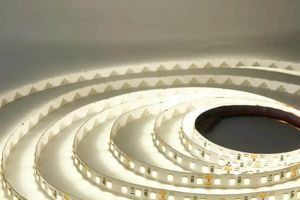
A word on density: for outdoor lighting, do not cut corners on the number of LEDs per metre. A minimum of 60 LEDs/m for decorative lighting and 120 LEDs/m or more for functional lighting. The higher the density, the more even the light output and the less visible individual hot spots through the compound.
Other Things to Check Before Buying
A few practical tips to help you avoid common mistakes:
- Buy with extra length. Outdoor installations often turn out longer than you expected at the start. Buying the exact same strip later can be difficult — batches may differ in colour temperature.
- Check the IP rating of the driver. Even if it sits under a canopy, IP65 is the safer choice — condensation and splashes are always a factor.
- Use weatherproof connectors. Joints are the most vulnerable point. Standard indoor connectors oxidise within a single season outdoors.
- Plan your section lengths. Long 230 V runs are convenient to install, but 12 V and 24 V systems have maximum run lengths before voltage drop becomes an issue — factor this in during planning.
Conclusion
Choosing an LED strip for outdoor use is not simply a matter of picking the brightest option. It is a question of durability and safety. A properly selected strip with an IP65–IP68 rating, quality silicone compound, UV-stabilised housing and a suitable driver will last five to seven years or more without losing brightness or waterproof integrity. Skimping on protection means replacing everything the very next season.
If you are selecting an LED strip for a specific outdoor project, the team at artled.com.ua is ready to help you find the right solution based on your installation conditions, local climate and budget.