LED Strip Density: 60, 120, or 240 Diodes per Meter — How to Choose Correctly
Density is the number of LEDs per meter of strip, and it's what determines brightness, light uniformity, and power draw. A 240-diode/m strip shines roughly twice as bright as 120 diodes/m and four times as bright as 60 diodes/m, but it draws proportionally more current and runs hotter. Density shouldn't be chosen on a "more is better" basis — it depends on viewing distance, profile type, and project budget. In this guide, the ARTLED team breaks down the difference between 60, 120, and 240 diodes per meter and gives guidance on which strip fits which task.
What LED Density Is and How It Affects Light
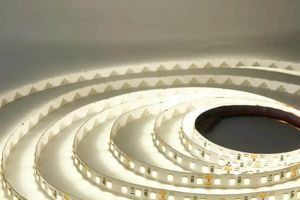
LEDs on a strip are placed in groups at equal intervals — it's this spacing between groups that defines density. The shorter the distance between diodes, the more even the light output, and the less noticeable individual points of light are, even without a diffuser.
✓ 60 diodes/m — spacing of about 16.6 mm, the most budget-friendly option
✓ 120 diodes/m — spacing of about 8.3 mm, the most common standard for most projects
✓ 240 diodes/m — spacing of about 4.2 mm, premium density for bright, maximally even light
Comparison Table: 60 vs 120 vs 240 Diodes/m
| Density | Power | Brightness (approx.) | Cut spacing |
|---|---|---|---|
| 60 diodes/m | 4.8–5 W/m | 450–500 lm/m | every 5 cm |
| 120 diodes/m | 9.6–10 W/m | 900–1000 lm/m | every 2.5 cm |
| 240 diodes/m | 19.2–20 W/m | 1900–2000 lm/m | every 1.25 cm |
The "Dotting" Effect: When It's Noticeable
Without a diffuser, or with a clear one, the eye sees not a continuous line of light but individual bright points — this is the "dotting" effect. How noticeable it is depends on three factors at once: strip density, diffuser type, and viewing distance.
✓ 60 diodes/m — dots are visible even with a frosted diffuser, especially at viewing distances under 1 m. Needs a deep profile with a milky diffuser like LRMe or equivalent.
✓ 120 diodes/m — with a frosted diffuser, dots are practically invisible; with a clear one, they're visible up close.
✓ 240 diodes/m — light looks like a continuous line even with a clear diffuser, thanks to the tight spacing between diodes.
Density, Power Draw, and Run Length
The higher the density, the more current flows through the strip's copper traces at the same length — and this directly affects voltage drop and heat output.
✓ Voltage drop. A 240-diode/m strip draws twice the current of 120 diodes/m, so the maximum run length from a single feed point is roughly halved — a detailed calculation and formula are in our guide on voltage drop in LED strips.
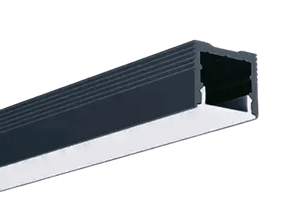
✓ Heat dissipation. 19.2 W/m on a 240-diode/m strip needs a deeper, wider aluminum profile than 4.8 W/m on 60 diodes/m — otherwise the chips overheat and degrade faster.
✓ Power supply sizing. A 5 m run of 240-diode/m strip needs a PSU rated around 96 W with headroom, while 60 diodes/m only needs 24–30 W.
Which Density to Choose for Your Task
✓ 60 diodes/m — background lighting behind a TV, ceiling coffers, decorative niche lighting with no direct view of the strip
✓ 120 diodes/m — the universal choice: shelf, cabinet, and ceiling-perimeter lighting, most residential projects
✓ 240 diodes/m — kitchen countertop task lighting, bathroom mirror lighting, retail displays and commercial spaces needing high brightness with zero visible dotting up close
Common Mistakes
The most common mistake is choosing density by price alone, ignoring the application: a 60-diode/m strip in a profile with a clear diffuser on an open kitchen countertop will produce a row of bright dots instead of even light. A second common mistake is installing a 240-diode/m strip in a thin decorative profile without enough heat dissipation, which accelerates chip degradation. A third is not recalculating run length and PSU power when moving from 120 to 240 diodes/m, leading to voltage drop at the far end.
Frequently Asked Questions
Can different densities be mixed in one project?
Yes, this is common practice — for example, 240 diodes/m for a kitchen work zone and 120 diodes/m for background ceiling lighting in the same room, as long as they're fed from separate lines or controller channels.
Does density affect light color (CRI, color temperature)?
Not directly — CRI and color temperature depend on the specific chip, not on density. But a strip with more diodes per meter usually has a more even tone along its whole length, thanks to better binning.
What density should be chosen for COB LED strips?
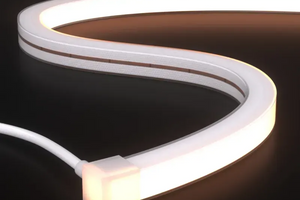
COB strips are a separate type where the diodes are packed so tightly (essentially a continuous band) that the traditional 60/120/240 classification doesn't apply — they inherently have no dotting effect.
Can a 120-diode/m strip be replaced with 240 diodes/m in the same profile?
Physically yes, if the profile is wide enough, but check the profile's heat dissipation and recalculate the power supply — 240 diodes/m draws twice the power.
Conclusion
LED strip density isn't a quality indicator — it's a parameter to match the task: 60 diodes/m for background light, 120 diodes/m as the universal standard, 240 diodes/m for bright task lighting and projects where the strip is viewed up close. Choosing the right density directly affects the diffuser, the profile, and the power supply calculation.
ARTLED offers LED strips in 60, 120, and 240 diodes/m density on Samsung and Epistar chips, with profile and diffuser selection for every project. ARTLED's team will help you determine the optimal density for your space and budget at no charge.