Choose an LED strip when you need maximum light output inside a hidden aluminum profile — kitchen under-cabinet lighting, shelves, ceiling coves, accent RGB lighting; choose neon flex when you need a solid, even line of light with no visible diode dots — a ceiling contour, a sign, a parapet, or architectural facade lighting. The difference isn't "quality" of one product over the other — it's construction: an open PCB with individual diodes versus that same PCB cast inside a silicone diffuser tube. That single fact drives everything else — light diffusion, default IP rating, minimum bend radius, and cut spacing. In this guide, the ARTLED team breaks down the difference by every criterion, so you don't overpay for neon where a strip in a profile is enough, and don't lose the even light line where neon is actually needed.
LED Strip vs Neon Flex: Comparison Table
| Criterion | LED Strip (SMD/COB) | Neon Flex (LED Neon) |
|---|---|---|
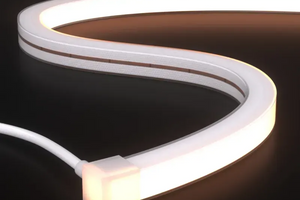
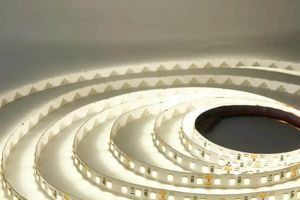
| Visual effect | Visible individual light dots (except COB) | A solid, even line with no dots |
| Default IP rating | IP20 (uncoated); a separate silicone coating or sleeve is needed for IP65+ | IP65–IP67 "out of the box" thanks to the solid silicone housing |
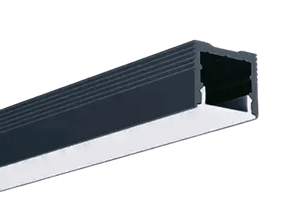
| Aluminum profile needed | Yes, for an even line and heat dissipation (especially COB) | Not necessarily — often mounted with its own silicone clips; a profile is optional for a recessed look |
| Minimum bend radius | "Vertical" bend only, from 20 mm (SMD) to 5–8 mm (COB) | 40–50 mm for standard neon; specific side-bend models — from 25–30 mm laterally |
| Cut step | Every 2.5–5 cm (depending on LED density) | Usually every 10 cm — a longer "dead zone" at the cut |
| Typical use | Kitchen, shelf, and stair lighting, RGB accents, addressable effects | Ceiling contours, signage, parapets, architectural facade lines |
Why Neon Gives an Even Line and a Strip Gives Dots
On a regular SMD LED strip, the diodes sit as individual points a few millimeters apart, and without an added diffuser, each diode is visible as a separate bright dot. In neon flex, that same diode-populated PCB is cast inside a solid silicone diffuser tube — light from each diode scatters through the silicone and blends into one even line with no brightness dips between the dots.
✓ An LED strip needs a profile with a milky or opal diffuser to produce an even line — on its own, without profile coverage, it always shows a dotted light pattern.
✓ COB strip is a middle ground: a continuous phosphor coating hides the individual chips and gives an almost even line even without a profile, though not as uniform as neon.
✓ Neon flex needs no additional diffuser at all — the even line comes from the silicone housing itself.
✓ Neon has a wider viewing angle — typically 180–220°, while an open strip shines mostly in one direction and needs a profile to control the direction.
Flexibility and Mounting: Where the Strip Wins, Where Neon Wins
A regular LED strip bends in only one plane — the "vertical" bend, wrapping around a rounded profile edge or a pipe, as described in the article on 90° corner joints for LED strips. The PCB cannot take a direct sideways turn — a corner is always handled by a separate connector, a wire jumper, or a corner profile.
✓ Standard neon flex bends smoothly in both directions within its working plane, following wavy or rounded contours without breaks.
✓ Sharp side corners require a side-bend neon variant — standard neon flex, just like a strip, isn't designed for a sharp lateral bend of the PCB inside the tube.
✓ Neon mounts without an aluminum profile — using its own silicone mounting clips or adhesive, which simplifies and lowers the cost of installation along long contour runs.
✓ A strip almost always needs a profile — not just for looks, but for heat dissipation, especially with high-power COB strips, which degrade faster without an aluminum heatsink.
Water Resistance and Outdoor Use
This doesn't mean a strip is unsuitable outdoors — waterproof IP65/IP67/IP68 versions exist and are widely used for facades and pathways. But for contour architectural lines specifically (parapets, canopies, signage), neon more often wins on simpler profile-free installation and a more consistent joint seal when using dedicated neon connectors with sealing caps.
Cutting and Connecting: What Limits Segment Length
✓ Cut only at the marked cut points — for both strip and neon. Cutting off-mark severs the copper trace up to the nearest working segment.
✓ Neon has a longer cut step (typically every 10 cm vs. 2.5–5 cm for a strip) — meaning less flexibility in fine-tuning segment length to a project's exact size.
✓ Neon connects only with dedicated neon connectors and end caps matching the specific tube profile (round, oval, flat) — universal clip connectors made for regular strips don't fit neon.
✓ For addressable (SPI) versions of both types, the Data-in → Data-out signal direction must always be preserved at any joint or segment extension.
What to Choose: By Application
| Task | What to choose |
|---|---|
| Kitchen under-cabinet, shelf, work zone lighting | LED strip in a profile with a clear/micro-prism diffuser — maximum brightness |
| Ceiling contour, parapet, recess under a stretch ceiling | Neon flex — an even line with no dots, even up close |
| Signage, logo, contour lettering | Neon flex — exactly what it's designed for |
| Facade architectural line, building contour | IP65/IP67 neon flex — fewer joints, simpler profile-free installation |
| Addressable RGB lighting with effects (gaming, festive) | Addressable LED strip — a wider choice of addressable models and pixel pitch |
| Stair, mirror, and furniture lighting | LED strip in a profile — needs precise positioning and heat dissipation |
Common Mistakes
The most common mistake is expecting a bare strip without a profile to produce the same even light pattern as neon — without a diffuser, the dots will always be visible. Others include: trying to bend standard neon into a sharp side corner instead of using a side-bend model; connecting neon with a universal strip clip connector instead of a dedicated neon connector; cutting neon off the mark because you're used to a strip's shorter cut step; mounting a strip without a profile and heatsink where heat dissipation is needed (a high-power COB strip on wood or drywall); and ignoring the voltage-based segment length limit — the rule is the same for both strip and neon.
Frequently Asked Questions
Can neon flex be replaced with a regular strip in a diffused profile?
Partially — a profile's milky diffuser gives a similar but not identical effect: the line will be less even up close, and the profile itself adds bulk and requires separate mounting, unlike neon's thin silicone clips.
Which has a higher light output per meter?
Generally, an open LED strip without a diffuser — light isn't lost passing through silicone or milky acrylic. Both neon and a diffused strip always trade raw lumens for evenness of the line.
Can neon be cut anywhere?
No, only at the marked cut points — see the article can you cut neon strip for details.
Does neon need a profile?
Not necessarily for surface mounting — neon attaches with its own clips. A neon profile is used when you need a recessed, flush installation with the ceiling or wall surface.
Which lasts longer outdoors?
At the same protection class (IP65/IP67), the durability difference is small — the deciding factors are the same for both: joint sealing quality, UV resistance of the housing, and the quality of the LEDs themselves.
Conclusion
LED strip and neon flex aren't competitors — they're tools for different jobs. A strip in a diffused profile gives maximum brightness for task and accent lighting; neon flex gives an even, dotless line wherever the contour matters more than raw lumens. The right choice isn't set by price per meter, but by the visual result a specific point in the project actually needs.
ARTLED supplies both SMD/COB LED strips with profiles for any task and flexible neon flex in various cross-sections and protection classes. The ARTLED team will help you pick the right option for your project for free — from a kitchen to architectural facade lighting.